![[Navigation
bar]](../../images/top.gif)
![[Home]](../../images/bottom.gif) |
A Matter of Fat |
| ||
|
Fat Facts
Understanding Cholesterol
The Meaning of "LEAN"
Fat Finder Quiz
Practical Tips to Reduce Fat in Any Meal
What About Ground
Beef?
![[bullet]](../../images/bullet.gif) |
Some fat in the diet is necessary for good health. It is a major source of energy and essential fatty acids (i.e. fatty acids that cannot be produced by the body). |
|
|
Fat is particularly important for the normal growth and development of children. |
|
|
Fat adds taste and enjoyment to food. |
|
|
High fat diets have been associated with higher risk of heart disease, obesity and some types of cancer. |
|
|
Fat in foods can be visible, like the fat on meat or poultry, or invisible such as the fat used in the processing or preparation of foods such as potato chips, muffins and french fries. |
|
|
Unlike the fat on meat or poultry, much of which can be trimmed off, the hidden or invisible fat cannot be removed. |
|
|
Another major source of fat is the fat we add to our foods, e.g., butter/margarine on toast or vegetables, cream sauces on pasta and dressings on salads. |
|
|
The largest proportion of fat in the Canadian diet comes from fats and oils, which include butter/margarine, salad dressings, mayonnaise, and fat used for frying. |
| Types of Fat
All foods that contain fat, whether they are of animal or vegetable origin, contain a mixture of saturated (SFA), monounsaturated (MUFA) and polyunsaturated (PUFA) fatty acids.
|
![[Beef
Fatty Acid Profile]](../../images/matter_fat/beef.gif) |
The Nutrition Recommendations for Canadians, 1990, state that we should consume no more than 30% of Calories from fat. No more than 10% of this should be saturated fat.
For an average female (19 - 49 years old consuming 1800-2000 Calories per day), 30% of calories from fat would equal about 65 grams of fat - or 16 teaspoons.
Similarly, males (19 - 49 years, consuming 2800-3000 Calories), could have 90 grams of fat - or 22 teaspoons. And, older adults (50 + years) require 60 grams of fat - or 15 teaspoons.
Lean beef fits well within these guidelines. For example, a 100 gram serving of broiled sirloin steak, trimmed of visible fat, provides 186 Calories and 6.7 grams of fat. A serving of broiled inside round steak has as little fat and cholesterol as an equal serving of roast chicken without the skin.
![[Recommended Daily
Fat Intake]](../../images/matter_fat/recdaily.gif)
![[Top of
Page]](../../images/button.gif)
Cholesterol is a structural component of every human cell and is necessary for the body to function properly. The body naturally produces most of the cholesterol that it needs using fats and carbohydrates as the primary building blocks. Cholesterol production is regulated according to the amount needed by the body, balanced by the amount available from foods in the diet. In most people, the cholesterol in the food we eat has little effect on blood cholesterol
Cholesterol in foods (dietary cholesterol)
In most people, the cholesterol from foods has a much smaller effect on their blood cholesterol level than does their intake of dietary fat. Research shows that the body normally compensates for an increase in dietary cholesterol by reducing absorption and/or production of cholesterol. When dietary cholesterol is reduced, the body absorbs more from foods in the diet and/or produces more in the liver to maintain its cholesterol supply. However, the primary dietary factor that increases blood cholesterol levels is excess fat.
Cholesterol in the blood (serum cholesterol)
Healthy blood cholesterol levels help promote heart health. Blood tests often measure total cholesterol as well as LDL and HDL cholesterol. LDL (low density lipoproteins) transport cholesterol to the tissues throughout the body. HDL (high density lipoproteins) collect cholesterol from the tissues and transport it back to the liver for recycling or disposal. A variety of factors affect LDL and HDL cholesterol levels. Low levels of LDL relative to HDL help to protect against heart disease.
Lowering blood cholesterol level through changes in eating habits
The best way to lower blood cholesterol is to reduce total fat intake. By reducing your total fat intake, you will also reduce your intake of saturated fat. However, not all saturated fatty acids affect blood cholesterol levels. Stearic acid, one of the main saturated fats in beef, has little effect on blood cholesterol levels.
It is also important to eat high fibre foods (whole grain breads and cereals and fruits and vegetables). Achieving a healthy weight and regular exercise can also reduce blood cholesterol levels.
Studies show that lean beef fits in cholesterol lowering diets
Recent research has demonstrated that lean beef can be included in effective cholesterol-lowering diets. Studies show that both healthy adults and those with high cholesterol levels can significantly lower their total blood cholesterol and LDL cholesterol levels by following lower fat diets that include lean beef. Research has also compared the cholesterol lowering effect of lower fat diets that include different protein choices. In studies conducted with healthy adults and those with high cholesterol levels showed that substituting chicken or fish for lean beef in low fat diets did not result in significant differences in blood cholesterol levels. These studies found that lower fat diets which include lean beef are as effective in lowering total blood cholesterol and LDL cholesterol as lower fat diets that include chicken or fish.
References:
|
Today's beef is on average 21% lower in cholesterol than it was 20 years ago. All beef cuts, except short ribs, qualify as "lean" when trimmed of visible fat (lean means it cannot have more than 10% fat).
In fact, a 90 gram serving of broiled sirloin steak has less fat (5.0 g) and cholesterol (65 mg) as an equal serving of skinless roasted chicken drumstick (6.3 g fat, 84 mg cholesterol). And ounce for ounce, lean beef has the same amount of cholesterol as a serving of salmon.
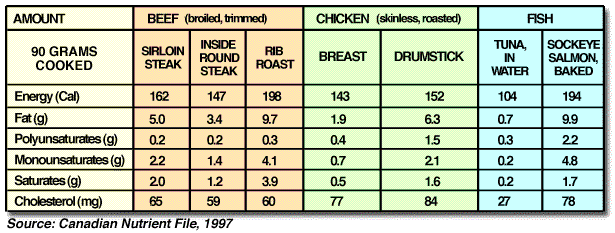

In order for a cut of meat to be classified as "lean" it must contain no more than 10% fat on a raw basis. Because today's beef is 50% leaner and 34% lower in calories than 20 years ago, all beef cuts, with the exception of short ribs, qualify as lean when trimmed of visible fat (eg. exterior fat). The leanest cut of all is inside round.
| Beef cuts (trimmed of visible fat, raw) | % Fat | Grams of fat
per 4 oz (120 g) raw |
| Very Lean (under 5%
fat / at least 95% lean) INSIDE ROUND STEAK |
2.1 | 2.5 |
| SIRLOIN STEAK | 3.8 | 4.6 |
| RUMP ROAST | 4.3 | 5.2 |
| EYE OF ROUND ROAST | 4.8 | 5.8 |
| Lean (5 - 10% fat / at
least 90% lean) OUTSIDE ROUND STEAK / ROAST |
5.1 | 6.1 |
| SIRLOIN TIP / INSIDE ROUND ROAST | 5.2 | 6.2 |
| EYE OF ROUND STEAK | 5.5 | 6.6 |
| STRIP LOIN STEAK | 5.6 | 6.7 |
| BLADE ROAST | 5.7 | 6.8 |
| TENDERLOIN | 5.8 | 7.0 |
| CROSS RIB / RIB EYE / RIB STEAK | 6.7 | 8.0 |
| T BONE / PORTERHOUSE / STEW / WING | 7.1 | 8.5 |
| BLADE STEAK | 7.2 | 8.6 |
| BRISKET | 7.3 | 8.8 |
| FLANK | 7.4 | 8.9 |
| RIB ROAST | 7.5 | 9.0 |
To Select Lean Beef Look For...
Preparation Tips to Keep Lean Beef Lean
![[Sources of Fat Pie
Chart]](../../images/matter_fat/source.gif)