Try the Iron Challenge!
It's a fun way to see how much you know about iron. |
|
|
Iron, found in food, keeps your body healthy! Iron helps carry oxygen to all parts of your body so you can grow, move and breathe. Too little iron in your body can lead to iron deficiency anemia that causes you to feel tired and irritable and can lower your attention span. In children, low iron levels can lead to a reduced ability to learn and depressed growth.
Practical information is provided below on iron and infants, teen girls and adult women.

|
|
For Health Professionals
 order order
download
|
How much iron do you need?
The Recommended Dietary Allowance (RDA) is the daily intake you should strive to achieve. If your usual intake meets or exceeds this level, it is almost certain you've met your requirement. Intakes below this level do not necessarily mean that your intake is not adequate but that the risk of not meeting your requirement is higher.
Recommended Dietary Allowance (RDA)
(mg/day - total iron intake)
|
| Ages |
Male (mg) |
Female (mg) |
| 0-6 monthsA |
0.27 |
0.27 |
| 7-12 months |
11 |
11 |
| 1-3 years |
7 |
7 |
| 4-8 years |
10 |
10 |
| 9-13 years |
8 |
8 |
| 14-18 years |
11 |
15 |
| 19-30 years |
8 |
18 |
| 31-50 years |
8 |
18 |
| 51-70 years |
8 |
8 |
| > 70 years |
8 |
8 |
| Pregnancy |
|
27 |
|
ARecommendations for infants 0 to 6 months are Adequate Intakes, based on the iron content of breast milk. For more information, visit Dietary Reference Intakes.
For those people who do not eat meat, fish or poultry, what is their RDA for iron?
Recommended intakes for vegetarians, people who do not eat meat, fish or poultry, are almost twice as much as those who do. You can estimate your recommendations by multiplying the RDA by 1.8. For example, the RDA for vegetarian women, 19-50 years of age, would be 32 mg of iron per day.
Iron and Infants
Iron is important for infants too. In fact, infants between 7 to 12 months of age are growing so fast that they need more iron than an adult man.
Recommended Dietary Allowance (RDA)
(mg/day - total iron intake)
|
| Ages |
Male (mg) |
Female (mg) |
| 0-6 monthsA |
0.27 |
0.27 |
| 7-12 months |
11 |
11 |
| 1-3 years |
7 |
7 |
ARecommendations for infants 0 to 6 months are Adequate Intakes,
based on the iron content of breast milk.
|
Tip!
|
- Introduce iron-rich foods, such as meat, between 6 and 9 months of age.
|
|
Iron and Teen Girls
Teen girls' iron requirements increase during adolescence due to the growth spurt and the onset of menstruation.
Teen girls who do not eat any meat, fish or poultry need almost twice as much iron as girls who do.
Iron and Adult Women
 New recommendations for iron are 40% higher than in the past. They reflect a new understanding of the varying needs of iron among women.
A woman's iron needs are even greater during pregnancy, if they have recently given blood, if they use an intra-uterine device and for those women who restrict their meat, fish or poultry intake.
Keep it simple - enjoy a variety of foods every day from Canada's Food Guide to Healthy Eating!
|
Tip!
|
- Iron supplements should only be taken after talking to a registered dietitian or a family doctor about your iron needs.
|
|
Can you have too much iron?
According to the Dietary Reference Intakes the Tolerable Upper Intake Levels for healthy adults is 45 mg of iron a day. This is based on risk of adverse gastrointestinal effects, such as constipation and nausea - especially when iron supplements are taken on an empty stomach.
Some people have a genetic disorder that causes the body to store too much iron; this is called haemochromatosis. An upper limit for people with heamochromatosis is not yet established. Before you reduce your intake of iron-rich foods consult your doctor or registered dietitian.
|
Tip!
|
- The best way to meet your iron requirement is by enjoying foods a variety of foods from Canada's Food Guide to Healthy Eating, like meat that has easily absorbable iron.
|
|
Iron is not all created equal
Only some iron in food is absorbed well by the body. Heme iron, found in meat, poultry, and fish is much better absorbed than the non-heme iron found in plants foods and eggs. For example, your body absorbs four times as much iron from a 90 gram serving of beef sirloin steak (cooked) than from a 175 mL (3/4 cup) serving of bran flakes.
|
|
|
 Non-Heme Iron
Sources |
|
There Are Two Types Of Iron In Foods:
Heme Iron And Non-Heme Iron
|
HEME IRON
|
NON-HEME IRON
|
- is more readily absorbed by the body (approximately 23% of the iron consumed is absorbed)
|
- is not absorbed as well as heme iron (only 3-8% of the iron consumed is absorbed)
|
- absorption is not changed by other foods
|
- absorption can be increased or decreased by other foods
|
- found only in meat, fish and poultry
|
- found in vegetables, fruit, grains and eggs
|
- important sources of heme iron: beef, organ meats (liver, kidney, heart) lamb, pork, veal, turkey, chicken, fish and seafood
|
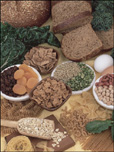
- important sources of non-heme iron:dried fruits (raisins, apricots)whole grain cereals, enriched cereals and pasta, dark green, leafy vegetables (spinach, chard, kale) legumes (lentils, dried peas or beans
|
|
Total Iron versus Absorbed Iron
The amount of iron that is actually absorbed by the body is more important than the total iron consumed when determining if you are getting enough. Although a bowl of bran flakes has more total iron, there is less iron absorbed compared to most heme sources.
aSource: Canadian Nutrient File, 2001
bValues were calculated based on zero iron stores and therefore
maximal absorption as described in Reference 24.
Beef Up Absorption!
Go for heme iron! Enjoy foods like meat, poultry or fish on a regular basis. One serving of cooked meat in Canada's Food Guide to Healthy Eating equals 50 to 100 grams - about the size of a deck of cards or a computer mouse. The amount your body absorbs is not changed by other foods you eat.
Choose colour! Try red, meats, dark green vegetables and brown grains.
|
Tip!
|
- Try a mixed bean salad instead of iceberg lettuce; or add lean beef to a tomato sauce.
|
|
Add iron enhancers! Certain foods can enhance the body's ability to absorb non-heme iron. These include meat, poultry, fish and foods rich in vitamin C like oranges, grapefruit, strawberries, cantaloupe or potatoes.
|
Tip!
|
- Try a glass of orange juice with a bowl of oatmeal cereal or add meat to your bean chili.
|
|
Look out for iron inhibitors!
Some components in tea and coffee can limit the amount of iron your body can absorb from foods with non-heme iron. To a lesser extent, oxolates in spinach or phytates in whole grains can also limit the amount of iron your body can absorb.
|
Tip!
|
- Avoid drinking coffee or tea with your meal. Wait for at least one hour after meals and/or choose juice or milk instead.
|
|
Looking for tasty, easy and nutritious recipes that feature lean beef? Visit our
Recipe Centre.
For a more in-depth review on iron, visit the
National Institute of Nutrition.
More references for iron.
For more information, visit Nutrition Research.
|