| buying and | | cooking
 |

|
The following are the most frequently asked questions about beef received by the Beef Information Centre. If you can't find the answer to your question here then contact us.
|
Buying
Cooking
Storage
Safe Food Handling
Raising Cattle
Ground Beef
What are Canada's top beef grades?
 Canada's top beef grades are Canada Prime, Canada AAA, Canada AA and Canada A. The difference between the four grades is the degree of marbling with the Canada Prime grade having the most marbling. The three A grades account for over 75% of beef produced in Canada. Canada Prime is mostly sold to restaurants or exported. Look for these grades in your retail flyer and at the beef counter or ask your meat department manager.

Is colour an indication of beef’s freshness?
 The majority of consumers select beef based on its bright red colour. However, variations in colour can be due to many factors, including the type of packaging and is not necessarily an indicator of freshness. The best indicator of freshness is the "packaged on" date or the "best before" date.
Can I age my beef in my refrigerator? I have heard that aging improves beef's tenderness.
Beef's tenderness improves with age, but aging cannot be accomplished safely in a home refrigerator. See Aging of Beef.
I saw a TV program that showed retailers often changing the best before dates on a package of meat in order to make if look fresh. Could they be doing this in my local store?
It is mandatory for retailers in Canada to put the packaging date or a "best before” date on fresh meat that has been packaged. This is monitored through the federal government’s Canadian Food Inspection Agency. In the United States, this practice is voluntary.
Retail-packaged foods must be labelled with either a durable life date (Best Before) and any necessary storage instruction, or a packaging date and accompanying durable life information, on the label or on a poster next to the food. (B.01.007 of the Food and Drug Regulations and in Section 94 of the Meat Inspection Regulations, 1990.) This includes fresh meat.
CFIA inspectors review food labels for accuracy, investigate complaints and lay charges against offenders.
Do retailers repackage meat to make it look better?
Retailers may often re-cut a cut of beef in order to meet consumer demand. For instance they may re-cut a roast into steaks. However, the date on the package of the re-cut beef must be the same as the original date on the original cut of beef.
How do you know that these processes are working?
The Beef Information Centre has a strong working relationship with Canadian retailers and we have faith in the industry to abide by their own quality and safety standards, as well as government regulations.
Where can I get further information on beef pricing?
The George Morris Centre, an independent, non-profit, agri-food "think tank", published a report on beef pricing.
The key points in this document are:
- the borders are closed to the shipment of live cattle. Prior to BSE, Canada shipped significant numbers of live animals to the USA for processing.
- Canadian processing plants are operating at capacity. The result is a severe over-supply of live cattle.
- boxed beef from youthful cattle can be sold into the USA market. If beef prices in Canada were significantly lower than US prices, beef would flow to where prices were higher. Therefore prices are based on supply and demand levels in North America, not just in Canada.
- there is no surplus of beef at either the consumer or packer level. The clear answer as to why cattle prices are so low is because there is a surplus of live cattle relative to the capacity of processing plants.
It is difficult time for beef producers. The loss of export markets has severely impacted the total value of the carcass. The value of a carcass is equal to the value for the sum of the parts. Many cuts, including variety meats such as liver and tripe, and thin meats, once represented a significant value in export markets. Popular cuts, such as grilling steaks and oven roasts must now be priced to carry these losses.
What cuts are the best value now?
We need consumers to buy cuts from the entire of the carcass, not just the expensive grilling steaks and premium roasts. Bargains are to be found in beef items such as grinds, pot roasts and stew beef. We need to sell more beef at fair value, not bargain basement prices. And we need to open our borders so that beef producers have markets for their live cattle.
What is a Tri-Tip Steak or Medallion?
Tri-Tip is a portion of the bottom sirloin. The muscle is triangular in shape, hence the name "tri-tip". It is about 5 cm (2 inches) thick and weighs about 750 grams to 1.5 kg. The section may be cut into strip-like steak portions, or the piece may be formed into medallions.
Tri-tip steaks have a wonderful beefy flavour, which marries well with marinades. Visit the virtual counter for cooking instructions, nutrition information and recipes. Try Prairie-Style Tri-Tip Steaks - the beef is marinated to further enhance the flavour.
Tri-tips are listed with most major retail banners. If it's not available, speak with your local meat manager, or call the customer service department of your retail chain requesting that the store in your area carry this cut.
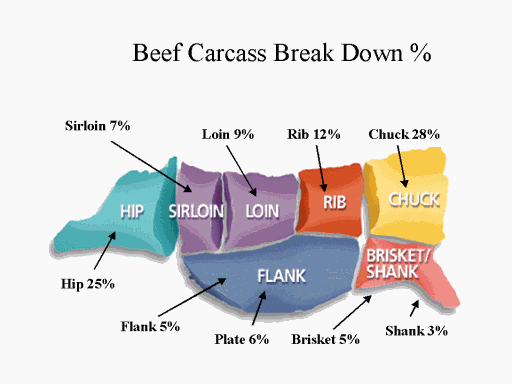
What affects the amount of beef cuts produced from a beef carcass?
Carcass rail weights range from 600-900 pounds. The usable yield or edible portions of beef cuts from a carcass is subject to many variables. For example, the amount of aging may reduce carcass weights by as much as 15% due to the loss of moisture in the meat. The amount of exterior fat that is left on the cuts will impact the final yield - zero or one-eighth-inch trim will yield less edible portion than one-half inch fat trim. The ratio of boneless to bone-in cuts will also be reflected in the final weight of the usable product. The lean content of the ground beef will also affect the usable yield. For example, regular ground beef, with up to 30% fat, requires the use of more fat than extra lean ground beef with only 10% fat.
These variables contribute to expected cutting and shrinkage losses anywhere from 25-60% of the original carcass weight.
See an illustration of the beef carcass breakdown by percentage and model cut yields.
What are the types of cuts you get from a beef carcass?
For a sense of what cuts may come from various primal cuts (chuck, loin, rib, etc.), visit the stylized carcass. Choose a primal, then select a subprimal to see the range of retail cuts that can be possibly merchandised from that section of the carcass. Bare in mind, it is an "either/or" situation; that is, the carcass is finite and you won't yield all of these cuts from the same carcass.
How can I make my beef more tender?
The less tender cuts of beef can be tenderized by marinating the meat before cooking either with a homemade or bottled marinade, or a store-bought quick marinade mix. Cooking the cut of beef according to the proper cooking method for that cut also will give you maximum tenderness. Stewing beef and pot roasts should be cooked in liquid for a long period of time.
Order FREE marinating booklet.
What cuts of beef should be marinated?
Check your meat label for the cooking method. If the label reads “marinating steak,” then this steak should be marinated to enable you to get the eating satisfaction you desire. The most common marinating steaks are: inside, outside and eye of round, sirloin tip and flank steaks. For cooking instructions see Marinating Steaks. Other cuts of beef can be marinated for 15 to 30 minutes to enhance their flavour.
Order a copy of Canadian Beef Marvellous Marinades.
I recently marinated some beef in vinegar -- when cooked, the meat had a rainbow sheen on the outside surface. What caused this?
This is called iridescence. It is a natural phenomenon that is often seen in sliced deli roast beef, corned beef and ham and occasionally in sliced fresh meat, as well. Iridescence does not indicate decreased quality nor does it compromise the safety of the meat.
Meat contains iron, fat and other components. When light hits a slice of meat, it splits into colours like a rainbow. There are various pigments in meat that can give it an iridescent or greenish cast when exposed to heat and processing. Wrapping the meat in airtight packages and storing it away from light can help prevent this situation.
How long can I store beef?
Storage times vary by beef cut. The larger the cut, the longer the storage period. Store in the original wrapper in the coldest part of the fridge. Overwrap for freezer storage. See Beef Storage Chart.
Order FREE booklet with refrigerator storage chart included.
The power went out and my meat in the freezer is starting to thaw. Is it safe? What about the meat in the fridge?
As long as your meat is still partially frozen, it can be safely re-frozen. If the meat has completely thawed, but is still very cold, cook it and freeze it as cooked beef. If the meat has thawed and is at room temperature it must be discarded.
Refrigerated meat and leftovers should be safe as along as power is out no more than 6 hours. Otherwise it must be disgarded.
Is it safe to eat medium-rare roast beef or steak? I have heard so many conflicting reports about what is safe to eat.
 Beef roasts and steaks can be enjoyed medium-rare because if bacteria are present they are found on the surface of the meat. The high temperatures reached on the surface of roasts or steaks during cooking will kill any bacteria. For medium-rare doneness, remove from the heat at 140°F/60°C; the temperature will rise an additional 5°F (3°C) during standing.
However, in the grinding process, any bacteria on the surface of meat are spread throughout. Therefore, ground beef (e.g. hamburgers and meatloaf) must be cooked thoroughly to 160°F (71°C).
Visit our virtual counter for a selection of beef roasts and roasting times.
Order FREE booklet with temperature rules for safe doneness.
I left a steak on the counter to defrost and forgot about it. Is it still safe to eat?
The Beef Information Centre recommends that you always defrost meat in the refrigerator, not on the counter.
Order your FREE guide to safe handling and preparation of foods at home.
Is there a need to rinse off beef cuts prior to cooking?
We recommend that people do NOT rinse meat (or poultry) before cooking. In fact, the meat would become waterlogged, making it soggy and less flavourful. Meat (and poultry) is ready to use right out of the package.
If there was any bacteria on the outer surface of the raw meat or poultry, the rinsing procedure could potentially cross-contaminate your sink. This would be especially problematic if you then washed fruits and vegetables in the sink (without sanitizing it first) and ate them raw.
The high temperature reached during cooking destroys any bacteria that is potentially on foods. The best way to tell if meats and poultry have reached proper doneness temperatures is to use a digital rapid-read thermometer to check the internal temperature in the centre of the food.
For more information, refer to the safe food handling section of the site.
I’ve heard about recent recalls from the CFIA – is my beef safe to eat?
Information on the recent recalls may be found on the Canadian Food Inspection Agency (CFIA) website.
According to the CFIA – some of the affected product may have been sold in Alberta, British Columbia, Saskatchewan, Manitoba and Ontario, but a listing of stores and products will be updated as necessary as the CFIA continues their investigation. Check their site for a complete listing.
The CFIA says that these products are likely no longer available for sale – as many of them were sold in June, July and August. However the CFIA is advising consumers who may have previously purchased these products and still have them in their freezers, not to eat them.
What is E. coli?
The digestive systems of all animals, including humans, are home to billions of essential bacteria. Escherichia coli or E. coli is one group of naturally-occurring bacteria in our intestine. Most types of E. coli do not cause illness in healthy humans. Some kinds of E. coli, however, cause cramps and diarrhea in humans. One dangerous type, called E.coli 0157:H7, produces a toxin that can cause severe illness.
E. coli 0157:H7 can be found in cattle, other farm animals, (i.e. pigs, sheep, etc) and wildlife, including deer. E.coli 0157:H7 can also be passed from person to person by unwashed hands, and from contact with contaminated water or manure. Bacteria can also be transferred to meat, including ground meat, unpasteurized milk and cider, and many fruits and vegetables.
Risks from illness caused by E. coli 0157:H7 are greatest for young children, the elderly, pregnant women, and anyone with ill health. However, everyone needs to guard against these bacteria.
For more information on E.coli 0157:H7 visit the Canadian Food Inspection Agency website or download the Beef Information Centre factsheet.
How can consumers protect themselves against E. coli?
There are a few simple steps consumers can take to protect themselves and their families from any foodborne illness, including E. coli 0157:H7:
- Cook ground beef patties to 71°C/160°F.
- Wash hands before and after handling food and frequently while cooking, especially after handling raw meat and poultry.
- Avoid cross contamination of food by washing utensils, plates and cutting boards that have come into contact with raw meat and poultry, in hot, soapy water.
- Refrigerate or freeze foods promptly.
What about ground beef?
It is important to cook ground beef - and all meats, poultry and eggs to the proper temperature. For ground beef it's 71°C or 160°F. The only way to tell if your food has reached a high enough internal temperature to destroy harmful bacteria, is to use a food thermometer. Visit the Health Canada website for a video demonstration on the proper handling of ground beef.
For a guide to safe handling and preparation of foods at home, order the Beef Information Centre's resource, Food Safety at Home: You're in Control.
Are there genetically modified beef cattle?
There are no genetically modified beef cattle in commercial production in Canada. Whether there ever will be depends on acceptance by both the beef producer and the consumer. The Canadian regulatory system ensures that before any genetically modified product is made commercially available, it must be evaluated for safety and effectiveness.
For more information, download the genetically modified organisms factsheet.
What is the difference between organic and regular beef?
While there are differences in the way organic beef is produced and in the retail price, both organic and conventional beef are of high quality, nutritious and safe. Lab tests have not found substantial nutritional differences and blind taste tests found consumers generally cannot tell the difference between organic and conventionally produced foods.
For more information, download organic beef factsheet.
I heard there was a recent case of Mad Cow disease in Canada. Is Canadian beef safe to eat?
Yes, Canadian beef is safe to eat. Canada's food safety system is among the best in the world. Detection of this disease is proof of the effectiveness of Canada's safeguards.
What is BSE?
BSE or "Mad Cow Disease" is a fatal disease of the nervous system of cattle.
For more information, visit the BSEinfo website or download a consumer factsheet on BSE.
Why is ground beef sometimes dark in the centre of the package? Is colouring added to meat or is this old meat in the centre?
Government regulations prohibit the use of colouring, additives or preservatives in fresh beef. See Colour.
What is the difference between extra lean, lean, medium and regular ground beef?
The difference is in the fat content. According to government regulations all ground meats are defined as follows:
- extra lean - no more than 10% fat
- lean - no more than 17% fat
- medium - no more than 23% fat
- regular - no more than 30% fat.
Lean and Extra Lean Ground Beef are part of the Health Check™ program. To learn more about Health Check™ and health-conscious cooking with ground beef, order Simply Nutritious Lean Ground Beef.
How do you handle a large (10 lb/4.5 kg or less) frozen sausage-like tube of ground beef?
* Cut the frozen block into family-sized meal portions using a clean serrated knife - this is tricky but it can be done. Wrap the pieces and freeze.
* OR cook the entire block (from frozen) all at one time - ideally, cutting it into manageable chunks first. Cook in a heavy covered canning kettle over medium-low heat, stirring occasionally. Divide the cooked ground beef into portions and freeze.
I've heard about rinsing cooked ground beef. How do you do it and why?
Rinsing cooked ground beef can reduce the fat content. For example, rinsed Regular ground beef crumbles has less fat than that of Lean ground beef crumbles.
Simply pan-fry crumbles until well done. After draining fat, pour crumbles into a colander or strainer while holding over the sink. Using hot water, rinse the crumbles well. Shake the colander to remove excess moisture.
Is irradiation of ground beef approved in Canada?
NO. Health Canada completed the technological assessment of the Canadian Cattlemen's Association submission to irradiate ground beef in November 2000 and the submission received a favourable recommendation. The regulatory development process is moving forward and the submission has been published in Gazette Part I. Once the process, which includes a consultative period, is complete, consumers will have the option of choosing irradiated or non-irradiated ground beef.
See Health Canada's news release.
What is food irradiation?
Food irradiation is a food safety technology that can greatly reduce disease-causing bacteria from foods. Like pasteurization of milk and pressure-cooking of canned foods, irradiating food kills bacteria and parasites that could otherwise cause food-borne disease.
See Health Canada's backgrounder for more information.
Does irradiated food contain radioactive particles?
Irradiated food is not radioactive. Irradiated food has been exposed to radiant energy in order to reduce or kill harmful bacteria, much like the pasteurization of milk or the pressure-cooking of canned foods.
If I could buy irradiated hamburger – would I be safe from E.coli?
The risk from E.coli is signficiantly reduced as E.coli 0157:H7 is very sensitive to irradiation. But it is important to remember that while irradiation is a useful tool for helping reduce risk of food-borne disease, it is not a replacement for proper handling practices by producers, processors and consumers.
How safe are irradiated foods?
Irradiated foods have been endorsed by the World Health Organization (WHO) and the Food and Agriculture Organization (FAO) of the United Nations. Worldwide, 38 countries permit irradiation of food. Irradiation is a regulated food process in Canada. Health Canada is responsible for determining which foods can be irradiated, and what levels of radiation can be used.
For more information, see Food Irradiation Factsheet.
How can I tell if food has been irradiated?
Government regulations state that all wholly irradiated foods in Canada must be clearly identified with both a written statement such as "irradiated" and the international symbol called the "radura".
See Health Canada's backgrounder for more information.
What foods are approved for irradiation in Canada?
Irradiated foods are not new in Canada. The first products were approved for irradiation more than 40 years ago. Currently potatoes, onions, wheat (including flour), and spices are approved for irradiation and sale in Canada.
I recently made some meat pies and cabbage rolls using ground beef. Even though a thermometer indicated that they were thoroughly cooked, the meat inside stayed pink. What caused this pinkness?
Ground beef products that are cooked to an internal temperature of 160ºF (71ºC) are completely cooked, regardless of colour. However, there are some factors that can influence the colour of cooked ground beef:
· Since fat influences heat conduction, lower-fat ground beef may take longer to reach 160ºF (71ºC) and can remain pink even after this temperature has been reached.
· Presence of nitrates/nitrites - Naturally-occurring nitrates found in water and vegetables such as celery, cabbage, radishes, turnips, spinach, parsley, etc. convert to nitrites which prevent raw beef from turning grey/brown when it is cooked. Similarly, cooked beef will also remain pink if ingredients such as cured meats (bacon, ham, etc.), hickory smoked products/seasonings or pickling/preserving compounds are added or come into contact with raw ground beef products.
· Muscle pigments called myoglobin carry oxygen and give meat its red colour. Meat from older cattle or from muscles that are used more often will remain red longer during cooking due to higher levels of myoglobin.
· Meat that is less acidic can also remain pink after cooking, as the pigments in meat are changed to their brown-coloured state more slowly in this case. This situation may occur in meat produced from cattle processed in the spring and fall when rapid temperature changes result in stress.
· Presence of carbon monoxide - Carbon monoxide will combine with the natural pigments in meat to produce a red/pink colour in cooked ground beef products. Minute amounts of carbon monoxide may be emitted by inefficiently burning flames in gas grills or ovens.
© 2008 | Beef Information Centre
|
|