Trends & Updates
 |
CATTLE INDUSTRY TRENDS
Canfax, a division of the Canadian Cattlemen's Association, provides expert analysis of markets and trends in the ever-changing North American beef industry. This information will help you better understand the beef industry and what effects the quality and the price you pay for beef.
The New Normal
There’s no question that the discovery on May 20th of a single cow with BSE has changed the landscape for the
Canadian beef industry. But the questions remains, is today’s situation the "new normal" or will it improve? Will
market conditions ever return to where they were before May 20th?
As countries begin to open their borders to some beef products (and eventually to live cattle sales), market conditions
should also improve. Cattle and beef prices are generally based on supply and demand fundamentals. When the borders
were completely closed to exports, beef supplies (especially certain products and cuts) were greater than the domestic
market could handle and the result was lower beef prices. As borders partially opened for beef exports, prices
increased as demand grew. However, a closed border to live cattle trade still means too many cattle with no place to go
in Canada.
The cattle and beef market in this country (and the US) has been built on an integrated North American base. It’s not
just Canadian supplies and domestic demand that dictate price, but the overall North American situation. Since the US
market is almost 10 times larger than Canada, pricing tends to be driven by the US market. On the beef side of the
business, prices have risen dramatically since borders started to open and Canadian beef is competing with the recent
record high prices south of the line. Cattle prices are still below their US equivalent but should also catch up once
cattle start moving south again.
So why does Canada need to have an export cattle and beef industry given the disruptive nature of closed borders? The
Canadian beef industry has grown dramatically over the past 15 years with beef cow numbers sitting at the largest in
history the day the border closed on May 20th. This expansion in the herd was built completely on growth in export
markets. We can't consume all we produce, so in order to maintain a healthy industry we need to sell our beef and
cattle elsewhere.
There are some key differences between Canada and the US over the past six months. As the US cattle supply became
tighter, carcass weights declined as cattle went to market earlier. Current US steer weights are down 21 lbs. from a
year ago at 809 lbs. while in Canada those steers have grown to 865 lbs., slightly higher than one year ago. When the
border opens to live cattle, the Canadian industry will normalize and the cattle weights between the countries will
become closer. Cattle in feedlots, ready for processing in Canada are down 29% compared to last year and all
indications are that they will remain significantly below previous years for the next six months. As a result, Canada
will not have an oversupply of cattle for the next six months.
Some beef products are being priced well under US price while others are comparable. For example, the tenderloin 5up
sells at 16.21 CDN in the US while the price here in Canada is $13.85.
The "new normal" is likely not fully determined yet. We have learned a critical lesson in taking care of the "home
front" and the importance of our domestic markets. And we have learned that there are no crystal balls or historical
trends to follow - the new normal is that there isn't a "normal" right now. Watch the markets, and make decisions based
on what you know today.

The BSE Situation
On May 20, 2025 the Canadian cattle and beef business changed dramatically when one cow from northern Alberta
tested positive for BSE (Bovine Spongiform Encephalopathy). Borders were closed to Canadian beef immediately, including
our largest and nearest trading partner, the US. Cattle markets ground to a halt and packing plant processing levels
were cut by more than half as the industry tried to deal with a closed border.
Why does the border closure have such a huge impact on the industry?
As outlined in the front-page article of this issue, exports account for a
huge portion of Canadian production. It doesn’t take long to see that when
more than half of our production is exported, such an immediate and
drastic effect occurs in the domestic marketplace when the border closes.
Canadians still want to eat beef (and want more of it at lower prices) but it soon became evident that with smaller
processing levels at the packing plants; there wasn’t enough of the high demand middle meats to satisfy consumer needs.
US imports of these cuts increased - at a time when cattle supplies were surplus - a frustrating situation to say the
least. These middle meats make up roughly 28% of the total carcass but the other 72% has to be sold as well. Many of
these other products, like hip and chuck cuts have previously been sold into the export market. Asian markets
especially have been very important for offal products like tongues, heart, liver, cheek and head meat in recent years.
These markets added value to products that previously had very little value in Canada.
Carcass Weights
Much has been said over the past couple of years about heavier carcass weights and their upward trend. Heavier carcasses mean bigger muscles - and that makes it tough to cut those thick 6 and 8-ounce steaks that consumers want. The reasons for this trend range from markets to weather to genetics to management to feed costs. The total average carcass weight (steers, heifers, cows and bulls) is up 17 lbs. from 2001 to 788 lbs.
Markets, prices and profitability are reasons that feedlots hold cattle and continue to feed or send for processing. Profitable feedlot margins tend to encourage operators to send cattle to processing in moneymaking times; however, the past year has been far from profitable and thus, no desire to sell cattle early. Weather and feedlot performance both play a part in how cattle gain weight so the recent mild winters in western Canada have meant better weight gains and heavier cattle. The genetic factor is more relevant to the long-term trend in carcass weights today versus 20 years ago, but as producers gather more individual animal information on rates of gain, they are better able to select for these trends (these animals cost less to produce per pound). Historically, higher feed costs have been a reason to sell cattle on or ahead of schedule but that wasn't the case in 2001. The last time high grain prices caused early selling was back in 1996. Today's grain prices are nearing those 1996 levels and could limit weights through the remainder of the year.
Management styles and trends are also affecting carcass weights. With more cattle destined for branded beef programs, there is an increase in the number of cattle needed to meet the higher AAA marbling scores specified for these programs. Often, in order to get cattle into the higher end programs (from a marbling perspective), cattle are fed longer. The obvious result is heavier carcass weights.
The trend to heavier cattle does not appear to be lessening and the industry is working on ways to merchandise these heavier cuts - beef cuts like the strip loin medallions are gaining popularity, both with the restaurant operator and with consumers.
Drought and the Beef Market
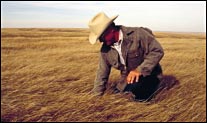 Drought throughout many parts of Canada in 2002 has been a key topic of discussion from coffee shop to board table. Even urban media got caught up in the action, suddenly becoming experts on drought. Unfortunately for agriculture, drought is a fairly regular occurrence somewhere in the world. Producers in drought-prone areas manage for drought in their long-term management plans. But when a severe drought hits areas not accustomed to it, there's little time to react. From a cattle producer's perspective, cattle still need to be fed and watered even though the grass isn't growing and the dug-out's gone dry.
Cattle producers in central/east central Alberta and west central Saskatchewan were faced with just that. Many cows and calves had to be moved out of the drought area which meant some going directly to slaughter (Alberta's cow slaughter is up 19% and Saskatchewan's is up 18%), some being sold to other areas in the country with better moisture conditions (and therefore grass and water) and some moving temporarily to other ranches to be fed and then returned when conditions improved. Many spring-born calves were placed into feedlots during the summer whereas that would typically occur during the fall.
Another issue with drought is that grain prices increase due to a smaller harvest. Feed and grain are a cattle producer's number one cost. Typically, as costs to grow cattle increase, prices for calves (down the chain) are lower. That fall, calf prices were roughly $165/head less than fall 2001. As well, with high costs of feed, Western Canadian feedlots are not as competitive with their U.S. counterparts and many Canadian calves have made their way into the U.S. so far this year.
As far as drought's direct effect on beef prices at the consumer level, very little has changed. Overall beef supply levels in 2002 will be near record levels. In the shorter run, wholesale beef prices seasonally strengthen into the winter, looking once again to peak in the spring of 2003. Although placement patterns in Western Canada have been affected by the drought, price trends will still be dictated by a much larger North American supply. Longer term, fewer cows after the sell-off of 2002 will mean fewer calves available in 2003.
Seasonality
You'd think beef markets would be pretty easy to figure out. Beef is a supply and demand driven commodity so if there is lots of supply, prices are low and if supplies are tight, then prices are high. Simple, right? Well, actually, no. Within the "big picture" supply and demand equation there is also the impact of time of the year. This is called seasonality and refers to certain times of the year when supplies or demand might dictate price direction.
Starting with the basic cattle supply, since the bulk of Canada's beef calves are born in the spring (rather than evenly throughout the year), and it takes 12 - 18 months to be ready for market, it stands to reason that most of them will make it to the beef market at about the same time - the following summer/fall. Prices for finished steers and heifers almost always make their annual price low in late summer.
On the flip side, supplies of market-ready cattle are usually quite small during the first quarter of the year, before the cycle starts again and often the price highs are made during that timeframe. A completely different timing and seasonality applies to cow marketings and therefore pricing of hamburger or manufacturing beef.
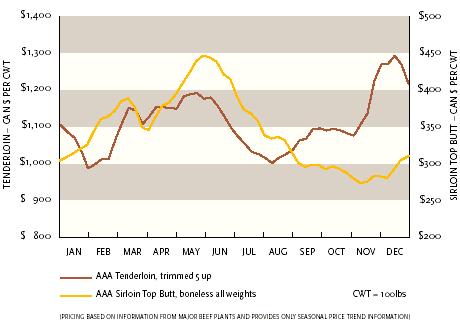
From there, you'll quickly understand that there are strong price "seasons" on various beef cuts. This often matches up with when consumers are looking for (or not looking for) specific cuts for specific purposes, i.e., strip loins to barbeque in the spring or a prime rib roast for the holiday season. Since demand is low for chuck cuts during the summer, prices are at their lowest then but experience price highs during the winter months when consumers are looking for "comfort foods". Loin cuts tend to have their highest prices year in and year out during the April through June period - fire up the BBQ!
It's all a matter of understanding the basic principles of seasonality and then applying those principles when planning your menu and your features.
Canadian AAA Tenderloin vs Sirloin Top Butt Prices 3 yr. avg.