Food Safety
 |
Every year in Canada, there are many food borne illness cases that originate from poor food handling practices. Whether you run a hot dog stand or a chain of restaurants, safe food handling is vital. What follows are straightforward dos, don’ts and tips that can keep your establishment as safe as possible.
Purchasing and Receiving
Know your supplier
Making sure you have a safe supply is critical. The beef you buy must come from a federally or provincially inspected facilities and must always be handled and delivered at the correct temperature to fully ensure you have safe product to work with.
Don’t assume your supply is safe
Foods from unreliable or disreputable sources may be cheaper but can contain high levels of pathogens or other forms of contamination. Buy all your food from approved sources only. Approved sources are those suppliers that are inspected for cleanliness and safety by a government or third party food inspector. Ask your supplier about their food safety procedures. Many suppliers have HACCP (Hazard Analysis Critical Control Point) plans in place to help ensure safe handling.
Monitor what comes in
When it comes to food borne illnesses, the buck stops with you. For this reason, you have to be aware of what comes in your receiving doors. Always monitor your suppliers, their delivery vehicles and personnel to ensure they’re handling the food safely. It’s a requirement that all food shall be packaged in such a way to prevent contamination during distribution. Potentially hazardous foods, like beef, must be transported in clean, covered vehicles under refrigeration at 4°C / 40°F or less. Frozen foods must be transported in the frozen state in covered vehicles which are at temperatures that will maintain the frozen state. (-18°C / 0°F or lower)
Inspect everything when it comes in
Check the condition of packaging, product and its temperature. Any food that shows signs of damage, spoilage, decay, filth, evidence of insect/vermin infestation or thawing should be returned to the supplier immediately.
Federal inspection
In Canada, federal inspection is required for any processing facility that is involved in inter-provincial or export trade of meat. Federal inspection is the responsibility of Health Canada and the Canadian Food Inspection Agency (CFIA). The Canadian meat inspection stamp on cartons means the product has been inspected for food safety, has been prepared in federally inspected facilities and meets a standard set of guidelines for both Canadian and international trade requirements. However it doesn’t mean that the product is Canadian. The stamp also contains the registered plant number for identification and tracing.
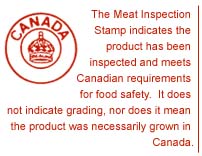
Provincial inspection
Inspection of provincially registered plants is the responsibility of the Ministry of Agriculture or Ministry of Health, depending on the province. Provincial guidelines will vary depending upon the standard set by the individual province. Provincially inspected meat may only be distributed within the province of inspection.

Handling
Because it can support the growth of harmful microbes, consuming improperly handled beef can be hazardous. The foodservice operator's responsibility is to ensure that hazards do not develop in any meat products under his or her management. To handle beef safely, it is important to keep in mind The Three Cs: Keep it cold, keep it clean and keep it covered.
Follow your nose
When vacuum packaged beef is first opened it will have a slightly off odour. The odour is normal and comes from the lactic acid bacteria that dominates when oxygen is not present. This smell will disappear after 15 to 20 minutes exposure to air. If it doesn't then carefully check the box code dates. A permanent odour means the product is spoiled and should not be used.
Specifically:
- keep food out of the Danger Zone between 4°C / 40°F and
60°C / 140°F
- wash and sanitize all equipment and preparation surfaces that have been in contact with raw meat before going on to the next task
- all food handlers must wash their hands properly, with soap and warm water after any task
- food handlers with cuts on their hands or arms must not handle food or utensils unless the cuts are properly covered - workers with cuts that are infected should not be involved in food preparation until the cut is healed
- it is crucial to prevent cross contamination of ready-to-eat foods such as salad or sandwich ingredients with raw meat items - separate preparation areas for each are strongly recommended
- avoid cross contamination between different meat products - thoroughly clean and sanitize the area and utensils before going on to the next cut
- similarly, never put cooked meat on the same plate or surface used for raw meat unless they've been thoroughly cleaned and sanitized
- unless the product is properly covered, microbes can float or drip from one product to another - covering also reduces shrinkage from evaporation
- do not re-freeze product once thawed
Storage
Keep your cool
Once the product is inspected and approved for use it should be moved to refrigeration as soon as possible to maintain the cold chain and food safety. Store fresh beef at 4°C / 40°F or less, frozen beef at -18°C / 0°F or lower. For best results, store fresh beef in the coldest area of the refrigerator. Always store cooked product above raw product to prevent cross contamination.
Good things come in sealed packages
Most beef will be vacuum packaged. Plastic vacuum packaging material is flexible, tough and durable. The film keeps oxygen from coming in contact with the surface of the beef, thus slowing down the growth of the bacteria. The natural tenderizing work of enzymes in the muscle continues without oxygen. Although the vacuum package is tough, it can easily be penetrated with a sharp object or have a faulty seal. Problem packages have lost their vacuum and are called "leakers." Such product should be returned to the supplier.
Purge
Vacuum packaged beef will have some purplish-red fluid inside the bag. This is known as purge or weep. Purge increases over time and some muscle cuts have more purge than others. After draining the purge, pat meat dry with a clean, lint-free paper towel. Purge is normal - excessive purge is not. A large amount of purge could be the result of the following: the product may have had temperature abuse in freezing; it may have been stored for an excessively long period of time; the package may lack a full vacuum or it may have been previously frozen. Discuss any of your concerns regarding this issue with your supplier.
Freezing
The general rule of thumb is freeze fast at low temperature. Processing plants rapidly freeze product in blast freezers or cryogenically with condensed liquid nitrogen. The faster meat is frozen, the smaller the ice crystals are that form within the cells. Smaller ice crystals keep the natural cell structure of meat intact and lead to less moisture loss.
Thawing
Thaw slowly at refrigeration temperature of 4°C / 40°F or less. As the ice crystals melt slowly there is less purge and the end result is moister and more flavourful. Remember, never re-freeze thawed product and always use the first-in first-out inventory rotation system.
Storing fresh beef
Meat cooler (-2 to 0°C or 28 to 32°F)
General cooler (1 to 2°C or 34 to 36°F)
|
Beef roasts/steaks
- opened packages | 2-4 days |
Beef roasts/steaks
- unopened vacuum packages | 1-2 weeks |
Ground or stew beef
- opened packages | 1-3 days |
Ground or stew beef
- unopened vacuum packages | max 10 days |
| Cooked ground beef | 2 to 3 days when cooked at the restaurant |
Storing frozen beef
Meat freezer (less than -24°C or -10°F)
General freezer (less than -18°C or 0°F)
|
| Beef roasts/steaks | 6 to 12 months |
| Ground or stew beef | 2 to 3 months |
| Cooked ground beef | 2 to 3 months |
Note: higher temperatures will result in shorter storage times.
Cooking
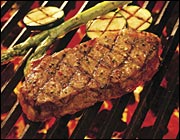 Proper cooking is one of the best ways of ensuring that the food you serve is safe. A common cause of undercooking meat or poultry comes from inadvertently preparing the meat while it’s still partially frozen. Here are some other tips to keep in mind:
- never rely on just cooking times or colour - always check the internal temperature of the food being cooked with an accurate digital food thermometer
- cooking should be carried out in one continuous process
- check the temperature of large cuts of meat or large batches of food in more than one location - to do this, insert the thermometer, away from bone, gristle or fat and leave it in for at least 30 seconds before reading the temperature
- clean and sanitize the thermometer between checks and between different types of foods
- ensure all potentially hazardous foods are cooked to the proper internal temperatures and never interrupt the cooking process or partially cook any potentially hazardous food - see the following chart
|
| Ground beef | 160ºF / 71ºC |
| Whole muscle beef and steaks | Rare: 140ºF / 60ºC
Medium: 155ºF / 68ºC
Well: 170ºF / 77ºC |
| Reheated leftovers | 165ºF / 74ºC |
More tips:
- keep cooked beef at 60°C / 140°F or higher until served
- rapidly chill cooked beef products that are to be refrigerated - cut large roasts into smaller pieces to allow for quicker cooling - once cooled, cover with plastic film
- reheat leftovers or other pre-cooked foods only once - if they are not consumed after being reheated, throw them out
- never use hot hold units to reheat foods - they are not designed to do this as they take too long - instead, use a rapid reheat method (e.g. stove-top, oven, etc.)
- label all food made in advance with the date of preparation for ease of stock control - generally potentially hazardous foods should be thrown out if not used up within 3 days from the date they were made - always use the FIFO principle for all food products (first in, first out)
- ensure that all foods are cooled
- from 60ºC / 140ºF to 20ºC / 70ºF within 2 hours or less AND
- from 20ºC / 70ºF to 4ºC / 40ºF in the next 4 hours or less.
(This guideline is for British Columbia - to find out what your district stipulates, consult your local Environmental Health Officer.)
Ground Beef
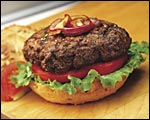 In the interior of whole muscle cuts (such as steaks and roasts) there is typically no bacterial contamination. However, when they’re cut, bacteria can multiply on the surface. But cooking these cuts on the rare side of "medium" is acceptable because there’s enough heat to kill any surface bacteria that are present. In ground beef, however, the surfaces where the bacterial contamination occurs is spread throughout the entire product in the grinding process. The only way to be sure that the bacteria are killed is to thoroughly cook the product. Here are some tips to ensure the ground beef you serve is as safe as possible.
Check points for ground beef deliveries:
- check the temperature - frozen should be -18°C (0°F) or lower, fresh should be 1°C (34°F) or lower
- check the label to make sure it is the product and quantity you ordered
- check the packaging to ensure an air tight vacuum seal exists. Boxes should be dry, clean and properly sealed
- check the colour - fresh should be bright cherry red; vacuum should be dark red or purplish; frozen should show no signs of freezer burn
- check the purge - fresh ground beef should not have excessive amounts at sides and bottom; frozen should have little or none
Thawing and cooking ground beef products
Because of the grinding process, ground beef products have bacteria spread throughout. It is very important to thoroughly cook all ground meat products:
- do not thaw ground beef products at room temperature or in warm water - cook from frozen if necessary
- ground beef and ground beef products must be cooked to an internal temperature of 71°C (160°F)
- make sure all patties sit flat on the grill for the entire cooking time - flatten if they start to curl
- make sure your cooking equipment can maintain hot temperatures of at least 190°C (375°F) even when loaded continuously with frozen burgers
- do not offer undercooked ground meat as an option for special orders
- do not rely on the colour of a cooked burger to determine doneness - test the temperature first
Hygiene
All those in favour, wash your hands
Even healthy people carry potentially harmful bacteria on their bodies. Because of this, anyone whose job involves handling food has an important responsibility to the public to prevent food from becoming contaminated. Washing your hands thoroughly is a good way to reduce the chance of passing on bacteria. This should include washing the backs of hands, wrists, between the fingers and under fingernails with soap and warm water (for at least 20 seconds). You must wash your hands:
- after visiting the washroom
- after handling raw food
- after using a handkerchief or tissue
- after handling garbage
- after touching your ears, nose, mouth or other parts of the body
- after smoking
- after every break
Washing hands is far less effective if they are not dried afterwards. Always dry your hands on single use, disposable paper towels or under an air dryer.


