Building A Beef Program
 |
STEAK PROGRAMS
Your guests love a great steak - one that tastes great and is cooked exactly the way they want it. Steak programs continue to thrive, with new steakhouses opening across the country and many restaurant chains focusing on steak items to build their business.
The following information is what you need to know in order to build a successful steak program.
Purchasing
Know your supplier
Ensuring you have a safe high quality supply of product is critical. The beef you buy must come from an inspected facility (federally or provincially inspected) and must always be handled safely and delivered at the right temperature to maintain quality.
Choose the grade of beef that meets your customers’ needs and budgets
Canada’s top beef grades are Prime, AAA, AA and A. Grading identifies eating quality and is done at the packing plant by the Canadian Beef Grading Agency (an independent third party). 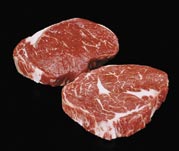 The eating quality is judged by the quantity of marbling or fine white streaks of fat running throughout the lean meat. Marbling contributes to tenderness, taste and juiciness. Prime has the most marbling, but supply of this product is very limited. The AAA grade is well marbled for excellent eating quality, and there is an abundant supply of product available in the marketplace. Choosing the grade you need is a matter of understanding your customers’ expectations as well as the cuts and cooking methods you are using. Your Canadian beef supplier can help you choose the grade that’s right for your restaurant.
Age your beef well
Like fine wine, beef improves with age. Aging is the process of storing beef under controlled temperature and humidity
conditions to allow the naturally occurring enzymes within the meat to slowly break down some of the connective tissues that contribute to toughness. Aging beef is proven to increase tenderness and flavour. Most foodservice operations specify beef aged between 21 and 28 days. After 28 days the natural enzyme action is virtually complete.
There are two ways to age beef:
- Wet aging - the aging of beef in vacuum packaging at 0 to 2°C
- Dry aging - the aging of carcass beef in a controlled environment of humidity and temperature at 0 to 2°C
.
Greater moisture losses occur with dry aging resulting in higher yield losses (shrink). Both methods are proven to have the same effect on tenderness. Wet aging is the most common and cost effective method of aging beef.
Branded programs
The beef industry has started to segregate and market product under brand name programs. These programs offer quality and consistency by identifying specific attributes that contribute to a quality eating experience such as a grade specification (eg. AAA), trim specification, breed, sizing criteria, etc. Some programs are also certified under the CBGA which monitors the criteria. This means that foodservice operators know exactly what they are getting when they purchase a branded product and they can market these brands on their menus. Canadian beef suppliers can give you the specific information on their branded program.

Choosing the right cuts
The numbers in small print are the North American Meat Processors Association (NAMP) and the Canadian Meat Council (CMC) purchasing code for that cut.
Cutting & Portion Control
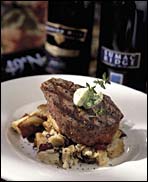 Proper steak cutting is another important step in achieving customer satisfaction. Excess fat should be trimmed to ensure the customer gets the most meat for the dollar. All gristle, sinew and cartilage should be removed to ensure maximum eating enjoyment. Ensure each steak is cut at right angles to and across the grain.
Many operators purchase steaks from their supplier that have already been cut into portion sizes. Consistent portion control is important to ensure customer satisfaction and consistent value for money.
Having your beef supplier provide you with portion-controlled steaks will:
- reduce your labour cost
- reduce waste
- eliminate the need to create other menu items to utilize the trim produced from in-house steak cutting
- ensure consistent portion control
- provide you with an exact cost for each steak for improved cost control
Cooking Steaks
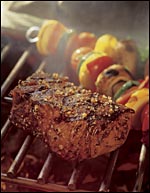 Your guests will come back again and again if their food is cooked to perfection and served exactly the way they expect it.
Cooking steaks correctly is an art, as well as a science. An understanding of degrees of doneness, knowledge of the cooking times for different cuts, sizes and thickness of steaks and a commitment to delivering the product exactly as ordered by the customer are the keys to a successful steak program.
A great steak starts tableside
Cooking a great steak starts with a knowledgeable server. Your server should be able to convey some important information to the customer about the kind of steaks you serve.
- The grade and age specifications of the beef you offer.
- The variety of steaks - and be able to describe in detail.
- How your steaks are cooked - this is very important. Every customer has an idea of how they like their steak cooked. Their idea of medium rare and the kitchen’s idea may be two different things. The server should describe the level of doneness to the customer to make sure both the server and the customer are clear on the expectation. The server then conveys this information to the kitchen. See the descriptions in this brochure.
Determining Doneness
Cooking steaks to their correct degree of doneness is something that must be mastered. Following are descriptions of degrees of doneness that servers can use to describe doneness.

Blue rare - seared on the outside, completely red throughout |
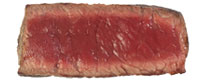
Rare - seared and still red 75% through the centre |

Medium rare - seared with 50% red centre |

Medium - seared outside, 25% pink showing inside |

Medium well - done throughout with a slight hint of pink |
Well done - broiled until 100% brown |
Managing doneness
It is a challenge to make sure each steak that leaves the kitchen is cooked just right. Here are some tips:
- make sure your equipment is working well, charbroiled jets should be clean and grill bars brushed and oiled to prevent sticking and flavour transfer
- make sure you have the broiler sections divided, a hot section for cooking rare and medium rare, a cooler section for finishing medium and medium well steaks as well as a lower heat section for finishing well done and briefly holding steaks for multiple orders
- steaks continue to cook after they leave the grill, take this into account when timing steaks for service
- bone-in steak cooks quicker than boneless, this needs to be taken into account when handling these steaks
Merchandising
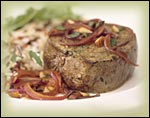 Serving steaks with sizzle! Chefs across Canada are becoming more and more creative with presentation and accompaniments that help build on the natural flavour of beef. Listed below are some ideas for your menu.
Filets
The traditional bacon wrap has been updated with proscuitto or pancetta wraps. Herb or spice crusts help to build flavour. Even bone-in presentations have made appearances on menus!
Strip loins
One of the newest presentations for steak has been the adaptation of a split strip loin. This cut provides a thicker presentation and more flexibility on doneness levels even in smaller 8 oz ranges. Other merchandising ideas include whole roasted or smoked strip loins carved and served with natural juices.
Other ideas include:
- pan-roasted portions for two, served with a variety of mushrooms
- top steaks with fresh fruit salsa spiced with fresh black pepper or exotic chillies
- cajun or southwestern spice crusts
Top sirloins
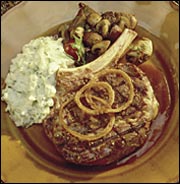 Steaks from this cut are thicker, giving the operator lots of options. Toppings on sirloins are a great way to increase perceived value and menu price. Some innovative toppings include:
- blue cheese and herb crust placed on the sirloin during the final stages of cooking and then brown the crust under the salamander
- grilled sirloin placed on trio of grilled onions (red, sweet white onions and green) and drizzled with a balsamic reduction
- teriyaki marinated sirloin grilled and served with ginger and garlic sautéed shrimp
Rib-eye
The rib-eye has great presentation value. The high marbling in this cut allows you to enhance the flavour in some innovative ways such as:
- using exotic wood chips to hot-smoke steaks (apple, mesquite, alderwood)
- placing the steak on a unique bread for a custom steak sandwich. For example: sourdough bread with herb butter, focaccia brushed with garlic butter and served with roasted garlic cloves for spreading
Tri-tip
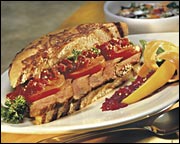 This cut has versatility and economy. Some ideas for this cut include:
- rolled in a custom spice blend and roasted whole. Slice and place on grilled gourmet bread
- marinate in a red wine and fresh herb marinade then grill and place on a baguette with melted Brie cheese and fresh ground pepper
- coat the steak in Indian spices, grill, slice and serve with rice and fruit chutney
Ideas for steaks, from a spice crust to unique toppings, are as varied as the chefs who create them. We encourage you to get the sizzle going with your steak program.


