General
 |
Disclaimer
Health Canada published new regulations in January 2003 making nutrition labelling mandatory for most packaged foods, including all ground meats and ground poultry.
Exemptions include:
- Raw single ingredient meats, poultry and fish, except for meat and poultry grinds
- Ground meats and ground poultry packaged on request at a full-service meat counter
The compliance date is December 12, 2005, unless you qualify as a small business, in which case you have until December 12, 2007. (A small business had gross revenues from sales of food in Canada of less than $1 million for the 12-month period immediately prior to December 12, 2002.)
What does the Nutrition Facts table look like?
Health Canada has specified formats that must be used to ensure that the Nutrition Facts table has a consistent appearance. The standard format will be used on most packages, if there is enough label space. A hierarchy of formats, in progressively smaller versions, may be used depending on the "available display surface" (ADS).
What is the Available Display Surface?
The “available display surface” (ADS) is used to determine which Nutrition Facts table format to use on the package. The ADS:
Includes
- the total package surface including the bottom as long as the contents do not leak or the food is not damaged if the package is turned over
- a package with the traditional tray and over wrap has the potential to leak and should not be labelled on the bottom of the package. In this case, the bottom surface area is not included when determining the ADS.
Excludes
- parts of the package where a label can't be applied or where the label wouldn't be legible
- UPC area
How do I determine the appropriate label format/size/placement?
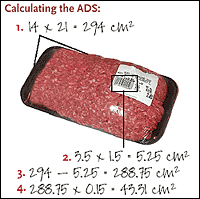
- Measure the area of the surface of the package, excluding the bottom if the package has the potential to leak.
- Measure the UPC area.
- Subtract the UPC area from the area of the surface of the package = ADS
- Multiply by 15%. The Nutrition Facts table is not required to (but may) take more than 15% of the ADS of a package.Example of determining the ADS
- Based on the hierarchy of sizes, choose the largest label which does not take more than 15% of the ADS.
Label placement and orientation
The Nutrition Facts table must be displayed on one continuous surface. The table must be oriented in the same manner as other information on the package if there is sufficient space. If there is insufficient space, the table may be oriented in another manner that fits on the package, e.g., rotated 90o.
For further information, refer to the:
Who is responsible for compliance and enforcement?
The accuracy of the nutrient values is the responsibility of the person who applies the label. This means the retailer for ground beef packaged in store; the processor for ground beef that is centrally packaged.
The Canadian Food Inspection Agency (CFIA) is responsible for enforcement of the new regulations. This will include assessing whether the Nutrition Facts table has been applied where required, the mandatory information and format are given, the nutrient values are accurate and claims are compliant. The procedure used to assess of the nutrition information is included in the CFIA Compliance Test for Nutrition Labelling.


